

In the summer of 2024, Disney, Hulu, and HBO Max bundled their services to stem the constant subscriber-to-cancellation pipeline.

For those old enough to remember cable, this is a humorous evolution.
Netflix persuaded us to “cut the cord” over a decade ago because cable had grown too bloated and powerful. When cracks in cable started to show, Hulu, HBO, Disney, and Paramount all followed suit.
Now, we are asking for one streaming platform to rule them all.
Humans are a silly bunch.
This pattern of consolidation to fragmentation (and sometimes consolidation again) has me thinking about power.
You can see it in politics, sports, business, and religion.
- The European Union → Brexit
- PGA Tour → LIV Golf
- Standard Oil → Splits into 34 companies
- The Catholic Church → Protestant Reformation
You also see it in tech.
For over a decade, big tech has been consolidating power. There was a time when Instagram, Slack, and YouTube were not yet synonymous with their conglomerates. (Facebook [now Meta], Salesforce, and Google [now Alphabet]).
When Sam Altman testified before Congress in 2023, he urged officials to regulate AI because of how powerful the technology would become. This is in stark contrast to the prickly performance of Bill Gates in his congressional deposition in 1998. Gates was called to testify for anti-competitive practices against Netscape, a popular browser at the time. Microsoft bundled Internet Explorer with its PCs, rather than providing users with a choice.
Netscape’s market share plummeted.
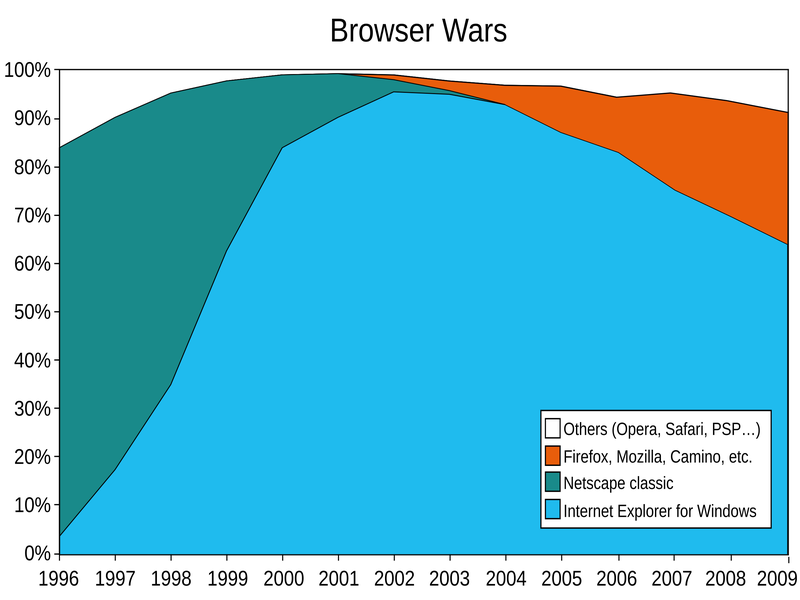
Microsoft had to pay $750 million to AOL, which had acquired Netscape, but the damage was done.
Many saw Altman’s trip to Capitol Hill as altruistic, a recognition from Big Tech that so much power shouldn’t be concentrated in the hands of so few, but to me, it seemed like the obvious choice when you consider history. Bill Gates famously warned Mark Zuckerberg to avoid his mistakes and “get an office in DC.” When Zuckerberg testified in 2018, he was more deferential and apologetic, and even open to regulation.
Altman’s trip in 2023 seems like an effort to get out in front of the impending backlash. In 1998, four of the top 10 companies in the S&P 500 were tech companies.
Today, nine out of 10 are.
The American consumer is no longer enamored with the magic of technology and the promise of inevitable progress. We’ve seen how easily infinite distribution can consolidate power.
Skepticism of consolidated power is as American as apple pie. Our entire system is based on checks and balances originating from a primal fear: too much power in the hands of one. But don’t forget, the United States is built on a bundle – thirteen colonies joined together to form one country
There is a tension in humanity about what to do with power. We fear the consolidation of power (tyranny), but we loathe the lack of coordination between ever-smaller competing factions. (Does the discussion of “there are too many nonprofits” ring a bell?)
Simply put, we are tired of switching between all the streaming platforms and want someone to eliminate the friction.
In software, I hear people say they want a “one-stop shop” because they are tired of jumping from one tool to the next and remembering all those passwords. And yet, the fact that we jump from tool to tool creates one of the few checks on power we have left.
The power to leave.
The reality is that consolidated power is usually more convenient.
One of the hardest parts of my job is persuading people to abandon the hope of the one-stop shop and instead cobble together a handful of tools to accomplish their goals.
Below the surface, I’m saying:
Forgo some convenience to reclaim your power.
For nonprofits that find themselves at the bottom of the food chain—receiving scraps from the tables of the wealthy, along with smaller and smaller portions from the government—a chance to reclaim power is rare.
As you jump between tools in your browser (Firefox? Chrome? Safari? Internet Explorer certainly isn’t around anymore.) and feel the prick of inconvenience, be reminded that this is one small way you demonstrate your power.
As long as you can jump between tools, the software companies work for you.